On 11/9/22 ,We visited the Doge’s Palace & the Correr museum located in the historical St Mark’s Square ,Venice. The museums depict the rich history of Venice .The amazing wealth of the Venetian city state is on full display in this museum. Its a worthy experience if you travel to Venice. There is so much history behind every piece of art work and artefact that you can spend many hours going through them. There are also guided tours offered by local guides, who can give you in depth history lessons.The correr museum has a beautiful collection of ancient maps, paintings and artefacts in the Napoleontic wing of the San Marco square. Some of the ancient maps are unique and date back to the 15th century !Enjoyed the mesmerising tour full of beautiful works of art & artefacts of the bygone era.


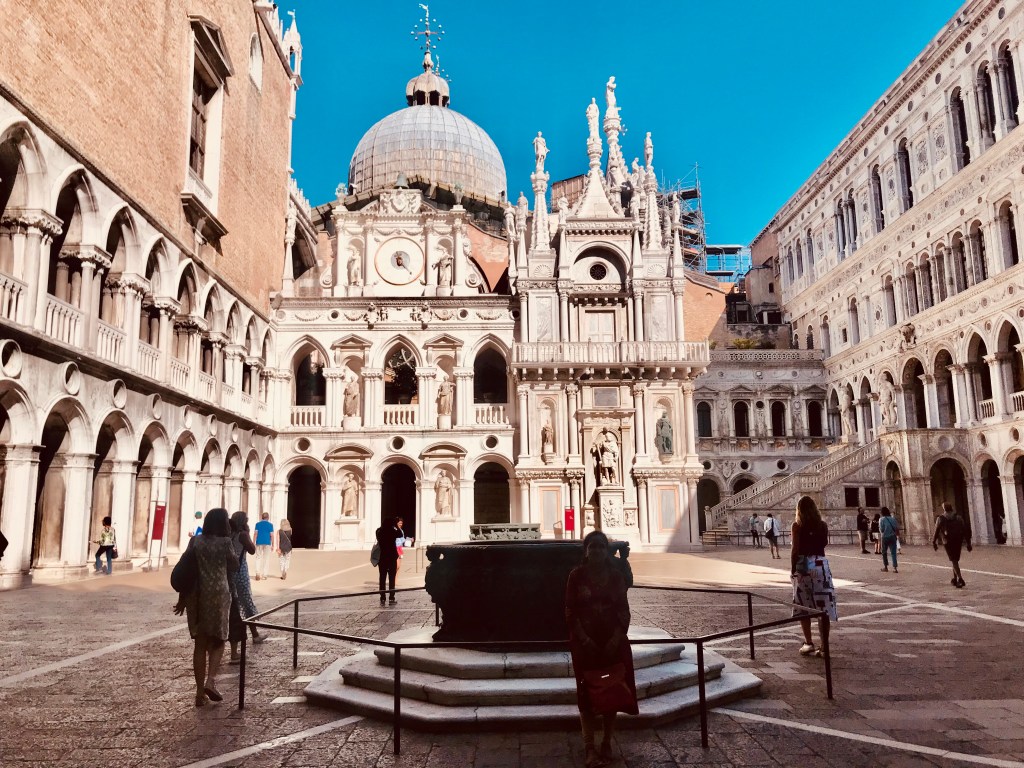


DOGE’S PALACE :
The Doge’s Palace (Italian: Palazzo Ducale; Venetian: Pałaso Dogal) is a palace built in Venetian Gothic style, and one of the main landmarks of the city of Venice in northern Italy. The palace was the residence of the Doge of Venice, the supreme authority of the former Republic. It was built in 1340 and extended and modified in the following centuries. It became a museum in 1923 and is one of the 11 museums run by the Fondazione Musei Civici di Venezia.


HISTORY :
In 810, Doge Agnello Participazio moved the seat of government from the island of Malamocco to the area of the present-day Rialto, when it was decided a palatium duci (Latin for “ducal palace”) should be built. However, no trace remains of that 9th-century building as the palace was partially destroyed in the 10th century by a fire. The following reconstruction works were undertaken at the behest of Doge Sebastiano Ziani (1172–1178). A great reformer, he would drastically change the entire layout of the St. Mark’s Square. The new palace was built out of fortresses, one façade to the Piazzetta, the other overlooking the St. Mark’s Basin.


As well as being the ducal residence, the palace housed political institutions of the Republic of Venice until the Napoleonic occupation of the city in 1797, when its role inevitably changed. Venice was subjected first to French rule, then to Austrian, and finally in 1866 it became part of Italy. Over this period, the palace was occupied by various administrative offices as well as housing the Biblioteca Marciana and other important cultural institutions within the city. By the end of the 19th century, the structure was showing clear signs of decay, and the Italian government set aside significant funds for its restoration and all public offices were moved elsewhere. In 1923, the Italian State, owner of the building, entrusted the management to the Venetian municipality to be run as a museum. Since 1996, the Doge’s Palace has been part of the Venetian museums network.


BRIDGE OF SIGHS :
The Bridge of Sighs (Italian: Ponte dei Sospiri) is a bridge in Venice, Italy. The enclosed bridge is made of white limestone, has windows with stone bars, passes over the Rio di Palazzo, and connects the New Prison (Prigioni Nuove) to the interrogation rooms in the Doge’s Palace. It was designed by Antonio Contino, whose uncle Antonio da Ponte designed the Rialto Bridge. It was built in 1600.

The view from the Bridge of Sighs was the last view of Venice that convicts saw before their imprisonment. The bridge’s English name was bequeathed by Lord Byron in the 19th century as a translation from the Italian “Ponte dei sospiri”,from the suggestion that prisoners would sigh at their final view of beautiful Venice through the window before being taken down to their cells.


MUSEO SAN MARCO (MUSEO CORRER) :

Museo Correr is a museum in Venice, northern Italy. Located in the St Mark’s Square, it is one of the 11 civic museums run by the Fondazione Musei Civici di Venezia. The museum extends along the southside of the square on the upper floors of the Procuratorie Nuove. With its rich and varied collections, the Museo Correr covers both the art and history of Venice.


HISTORY :
The Museo Correr originated with the collection bequeathed to the city of Venice in 1830 by Teodoro Correr. A member of a traditional Venetian family, Correr was a meticulous & passionate collector, dedicating most of his life to the collection of both works of art &documents or individual objects that reflected the history of Venice. Upon his death, all this material was donated to the city, together with the family’s Grand Canal palace which then housed it.The nobleman also left the city funds to be used in conserving & extending the collections & in making them available to the public.


The period when he was gathering his collections was a very particular one, as the Republic of Venice had fallen in 1797 and for decades thereafter the city would be under foreign rulers and out of real necessity, many Venetian families were eager to sell off their valuable collections. Several collections ended up being bought by foreigners, but in the early decades of the 19th century there were still many pieces on the market. An insatiable collector, Correr, from his youth bought all sorts of objects and dedicated all his resources in putting together an incredible amount of material. Correr would reveal himself to have a sharp eye, putting together a collection that was undoubtedly very original. He was explicit about his intention that the collections should be made available to the public, and the museum was finally open in 1836. Over the years, the contents of the museum would be catalogued and organized to provide scholars with a study facility and the general public with the opportunity to see the best from each individual collection. Subsequent bequests, donations and acquisitions would be added to the collection, ultimately leading to various pieces being housed on other venues.

My dear readers may kindly point out any incorrect information in my above writeup needing any corrections! I am truly indebted to Wikipedia & for the invaluable information on the subject !Happy Reading !
 Travel and Share
Excellent pics of Palace! These are worth seeing by all.
LikeLiked by 1 person
Glad that you liked the blog,sir🙏🏾
LikeLiked by 1 person
Most welcome 🙏
LikeLiked by 1 person
💕
LikeLike
Doge palace is definitely a landmark of Venice. The interiors of the palace are breathtaking. Pictures shared by you say it all. Impressive explanation of the stunning palace and the museum.
LikeLiked by 1 person
What an impressive palace
and ornamentation.Interiors look splendid.The fascinating history of the palace and museum makes this definitely an experience to have in a lifetime.
You have again presented it beautifully!
LikeLiked by 1 person
The ceilings are unbelievable!
LikeLiked by 2 people
Glad that you liked it 💕🙏🏾
LikeLiked by 1 person
What beautiful, natural sensuality these Italian statues possess ~ even the warriors and saints! I really enjoyed this ~ you did a wonderful job of photographic some very difficult exhibits in a way that made us feel we were really there. True skill! Thank you for bringing us with you.
LikeLiked by 2 people
Thank you so much for your lovely encouragement & kind appraisal of the blog on one of the most important Italian landmarks ! Kindly keep up your insightful comments on my other posts in your leisure time 🌷🌹❤️🙏🏾
LikeLike
From the photography, it is evident that OLD IS GOD precept is not wrong at all. The art and craft of yore proves that the expertise at that time was obviously stood out above everything else.
And the way you have written outstandingly after browsing and exploring the nook and corner of the historical buildings speaks volumes about your God given efficacy. Kudos to you for presentation of superb monuments with your camera – finesse in every way.
From the impressions of your write-ups and photographs it takes us to that time and we imagine how fine was the infra development of that time!
Please apprise my write-up too.
WARM REGARDS
HARBANS
LikeLiked by 1 person
Harbansji, as usual ,your magnificent appraisal of the blog has enhanced the elegance of the architectural monuments presented here!Thanks for the nice dose of encouragement pegging me on this journey of blogging 💕
LikeLiked by 1 person
Credit should go to the person responsible for research and putting the nitty gritty in proper perspectives.
Thanks a lot for for spreading awareness about the art and craft efficacy during the oldage in that part of the world.
Thanks and regards,
HARBANS
LikeLiked by 1 person
Thanks again dear sir for the analysis 🌷💕🙏🏾! By the way I couldn’t go through your post owing to many family errands🙏🏾
LikeLiked by 1 person
No problems sir, appraise whenever you have time.
Thanks and regards,
HARBANS
LikeLiked by 1 person
I love Venice and the Doges Palace, which is one of the most incredible sights. I haven’t seen many of the things on your list, however, so I’ll have to go back and check them out! Thanks for sharing!
LikeLiked by 1 person
My pleasure 🙏🏾
LikeLike
The way practice of functional consciousness through awareness meditation helps us to ultimately fall into eternal and infinite realms of pure consciousness ie awakening, in the same way travelling all around the world and exploring places may lead one to discover the eternal and infinite kingdom within and regain charge over lost kingdom in adolescent age. We arrive at our eternal palace and all wandering, desires etc drops like a kid drops coloured stones from his hands after discovering that the stone he found in his pocket is a diamond. My blog site for more from
LikeLiked by 1 person
What a gorgeous post, Dirhendra! I have never been to Venice, though long ago I visited Rome and Florence briefly. Thank you for sharing your travels with us, enriching our knowledge and appreciation! ❤
LikeLiked by 1 person
My pleasure!Thanks for your kind words of appreciation 🌷🙏
LikeLiked by 1 person
Interesting information and nice images. Your post reminds me of my recent visit to Venice. Some of the images in your posts do not show up.
LikeLiked by 1 person
Thanks for praising! As for the disappearing images, I tried to resolve it with WordPress but to no avail!Many of my blogs have been deprived of beautiful images which I had uploaded at the time of posting the blogs! Kindly bear with me 🙏
LikeLiked by 1 person
No worries. You can check your Media folder? Are the images still there?
LikeLiked by 1 person
Ok! Do you think deleting images in media folder(to reduce storage space) deletes them from the blogs! Pl give it a thought & help me out🤗
LikeLiked by 1 person
Yes of course. The best thing is to reduce the size of the photos before uploading them in media folder or blog post.
LikeLiked by 1 person
Ok! Thanks for the nice tip😊
LikeLiked by 1 person