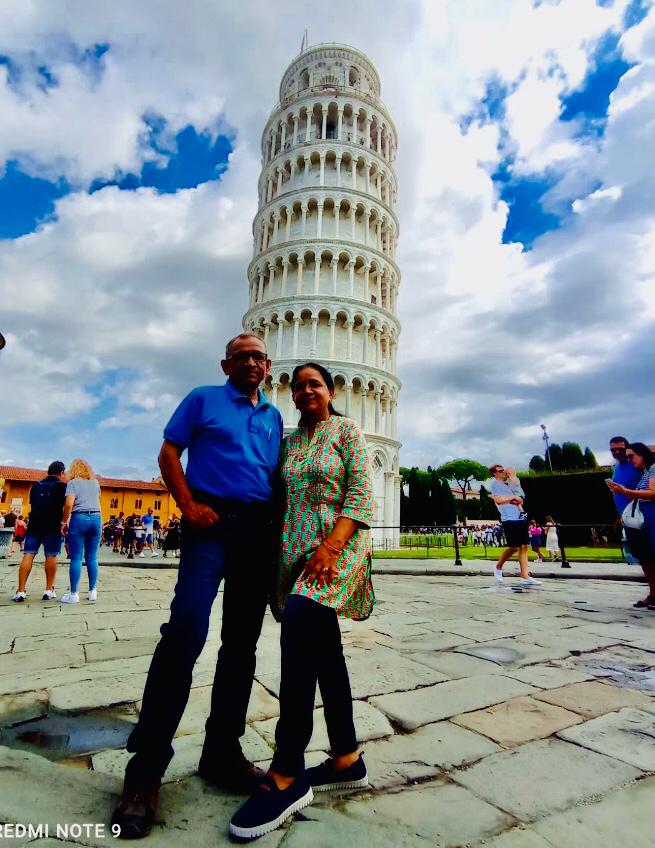
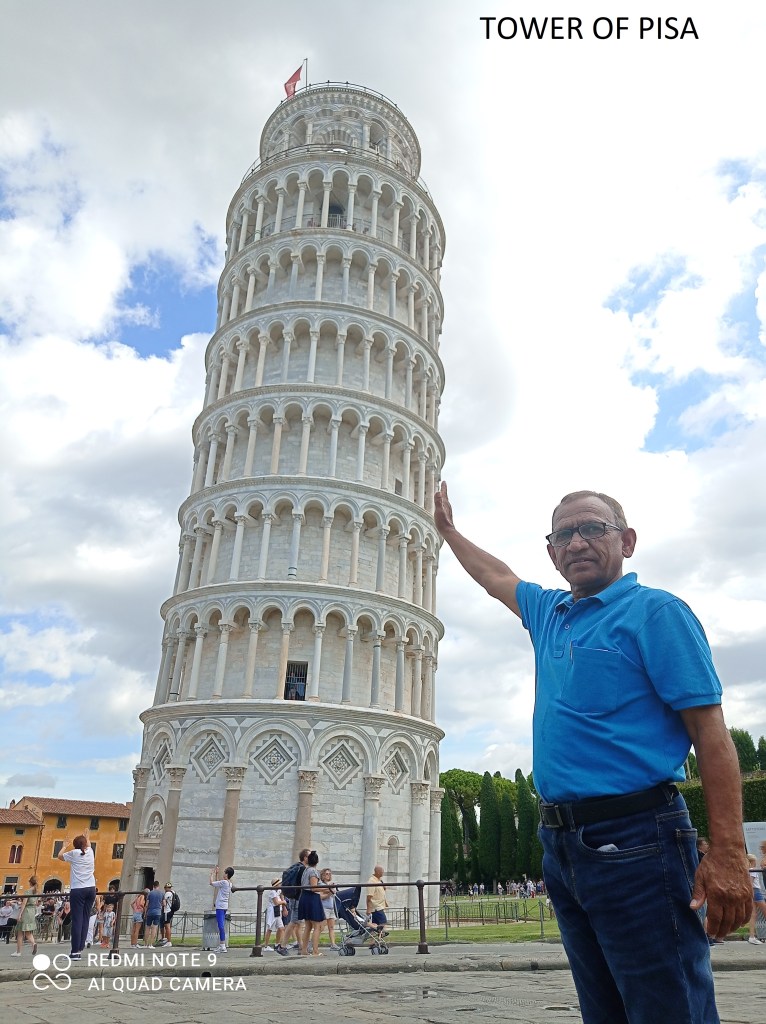


On 8/9/22 ,We took a train to Pisa from Rome & enjoyed the journey so much watching the great views of the sea & the ships embarked on the shore !In Pisa we were mesmerized by the view of the Cathedral Square. The square is dominated by four great religious edifices: the Pisa Cathedral, the Pisa Baptistry, the Campanile, and the Camposanto Monumentale (Monumental Cemetery).Having booked the tickets in advance,we quickly proceeded to experience the assend to the top of Pisa’s Leaning Tower.We could sense a strange feeling: after taking a few steps we could feel the tilt.Although its difficult explaining the same.But in all,it was an amazing experience which you gain only when you go through it.There are so many other remarkable places worth visiting in Pisa such as :Pisa Cathedral, Pisa Baptistery ,Museo delle Sinopie ,Bell tower of San Nicola & Museo del Duomo. Galileo Galilei was an Italian astronomer, physicist and engineer who was born in Pisa on 15 February 1564 .Here I am giving brief description of the worth-visiting places in Pisa for my valued readers.
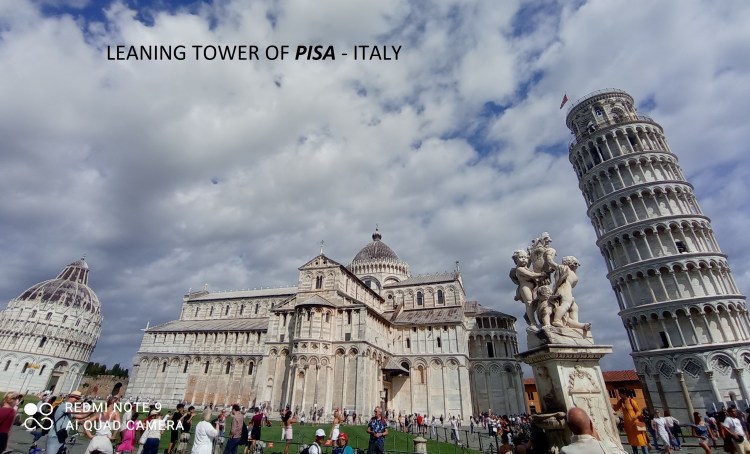
PISA :
Pisa is a city in Italy’s Tuscany region best known for its iconic Leaning Tower. Already tilting when it was completed in 1372, the 56m white-marble cylinder is the bell tower of the Romanesque, striped-marble cathedral that rises next to it in the Piazza dei Miracoli. Also in the piazza is the Baptistry, whose renowned acoustics are demonstrated by amateur singers daily,& the Caposanto Monumentale cemetery.The Leaning Tower of Pisa is one of the most famous constructions in the world. Its fame not only comes from the original trigger for its construction-to show the importance of this city after successfully attacking the city of Sicily, but also from its tilt, which has lasted for more than nine centuries.Pisa is also known for Pisa Cathedral, Pisa Baptistery ,Museo delle Sinopie ,Bell tower of San Nicola & Museo del Duomo.


THE LEANING TOWER OF PISA (Italian: torre pendente di Pisa)
The Tower of Pisa is the campanile, or freestanding bell tower, of Pisa Cathedral. It is known for its nearly four-degree lean, the result of an unstable foundation. The tower is one of three structures in the Pisa’s Cathedral Square (Piazza del Duomo), which includes the cathedral and Pisa Baptistry.
The height of the tower is 55.86 mts from the ground on the low side & 56.67 mts on the high side. The width of the walls at the base is 2.44 mts. Its weight is estimated at 14,500 tonnes.The tower has 296 or 294 steps; the seventh floor has two fewer steps on the north-facing staircase. The tower began to lean during construction in the 12th century, due to soft ground which could not properly support the structure weight. It worsened through the completion of construction in the 14th century. By 1990, the tilt had reached 5.5 degrees. The structure was stabilized by remedial work between 1993 & 2001, which reduced the tilt to 3.97 degrees.


ARCHITECT OF THE TOWER OF PISA :
For many years, the design was attributed to Guglielmo and Bonanno Pisano, a well-known 12th-century resident artist of Pisa, known for his bronze casting, particularly in the Pisa Duomo. Pisano left Pisa in 1185 for Monreale, Sicily, only to come back and die in his home town. A piece of cast bearing his name was discovered at the foot of the tower in 1820, but this may be related to the bronze door inThere has been controversy surrounding the identity of the architect of the Leaning the façade of the cathedral that was destroyed in 1595. A 2001 study seems to indicate Diotisalvi was the original architect, due to the time of construction and affinity with other Diotisalvi works, notably the bell tower of San Nicola and the Baptistery, both in Pisa.


Pisa Cathedral(Cattedrale Metropolitana Primaziale di Santa Maria Assunta):

It is a medieval Roman Catholic cathedral dedicated to the Assumption of the Virgin Mary, in the Piazza dei Miracoli in Pisa, Italy, the oldest of the three structures in the plaza followed by the Pisa Baptistry and the Campanile known as the Leaning Tower of Pisa. The cathedral is a notable example of Romanesque architecture, in particular the style known as Pisan Romanesque. Consecrated in 1118, it is the seat of the Archbishop of Pisa. Construction began in 1063 and was completed in 1092. Additional enlargements and a new facade were built in the 12th century and the roof was replaced after damage from a fire in 1595.
Pisa Baptistery of St. John (Italian: Battistero di San Giovanni) is a Roman Catholic ecclesiastical building in Pisa Italy. Construction started in 1152 to replace an older bapistery, and when it was completed in 1363, it became the second building, in chronological order, in the Piazza dei Miracoli, near the Duomo di Pisa and the cathedral’s free-standing campanile, the famous leaning tower of Pisa. The baptistery was designed by Diotisalvi, whose signature can be read on two pillars inside the building, with the date 1153. Its the largest baptistery in Italy, it is 54.86 m high, with a diameter of 34.13 m. The Pisa Baptistery is an example of the transition from the Romanesque style to the Gothic style: the lower section is in the Romanesque style, with rounded arches, while the upper sections are in the Gothic style, with pointed arches. The Baptistery is constructed of marble, as is common in Italian architecture.
PIAZZA DEI MIRACOLI (Italian:ˈpjattsa dei miˈraːkoli):
Its formally known as Piazza del Duomo (English: Cathedral Square), is a walled 8.87-hectare area located in Pisa, Tuscany, Italy, recognized as an important centre of European medieval art and one of the finest architectural complexes in the world. Considered sacred by the Catholic Church, its owner, the square is dominated by four great religious edifices: the Pisa Cathedral, the Pisa Baptistry, the Campanile, and the Camposanto Monumentale (Monumental Cemetery). Partly paved and partly grassed, the Piazza dei Miracoli is also the site of the Ospedale Nuovo di Santo Spirito (New Hospital of the Holy Spirit), which houses the Sinopias Museum (Italian: Museo delle Sinopie) and the Cathedral Museum (Italian: Museo dell’Opera del Duomo).
The name Piazza dei Miracoli was coined by the Italian writer and poet Gabriele d’Annunzio who, in his novel Forse che sì forse che no (1910), described the square as the “prato dei Miracoli”, or “meadow of miracles”. The square is sometimes called the Campo dei Miracoli (“Field of Miracles”). In 1987, the whole square was declared a UNESCO World Heritage Site.
MUSEO DELL’ OPERA DEL DUOMO :
The Museo dell’Opera del Duomo in Pisa is located in Pizza del Duomo , in the building that was the chapter house of the Primaziale , dating back to the 13th century, seminary, academy of fine arts and convent.It displays collected treasures of the cathedral & bapistery,including paintings & archaeological finds.
It was inaugurated in 1986 to house the cathedral’s treasury, the finds removed from sacred monuments for restoration and safeguarding reasons, and all those works that are no longer present in the various buildings of the monumental complex, but which required a public exhibition space. The museum takes its name from the organization that manages the monumental complex, i.e. the Opera del Duomo of Pisa.
MUSEO DELLE SINOPIE :
It was designed by Architect Giovanni di Simone in the 13th century & established as a shelter for Pilgrims & today its part of the Hospital of Santa Chiara.
The sinopias of the frescoes in the monumental cemetery are kept in the Museo delle sinopie in Piazza del Duomo in Pisa .The frescoes, the work of various artists, including Buffalmacco , Andrea Bonaiuti , Antonio Veneziano , Spinello Aretino , Taddeo Gaddi , Piero di Puccio , Benozzo Gozzoli and others, once covered the walls of the cemetery and were destroyed or in any case greatly damaged by the fire of 1944 due to an allied bombing.On that occasion the frescoes were detached for the very urgent restorations (largely still in progress) and these preparatory drawings were found to be extraordinarily preserved. After the restoration they were placed in today’s museum, which is located on the south side of the Piazza del Duomo, where there is one of the two ticket offices of the monumental complex.
BELL TOWER OF SAN NICOLA CHURCH ,PISA :
The octangular bell tower, the second most famous in the city after the Leaning Tower, most likely dates to 1170. There is no proof, but, as in the case of its other more famous counterpart, the architect seems to be Diotisalvi. Originally it was separated from the nearby buildings. It is also slightly tilting; the base is under the current street level.The lower part starts at the top of each side with blind arches including lozenges. The bell has instead a good plan, with a single mullioned window on each side, and is surrounded by a gallery with small arches supported by columns. The cusp has a pyramidal shape.The polychrome effect was obtained by using stones from different locations.
FONTANA DEI PUTTI :
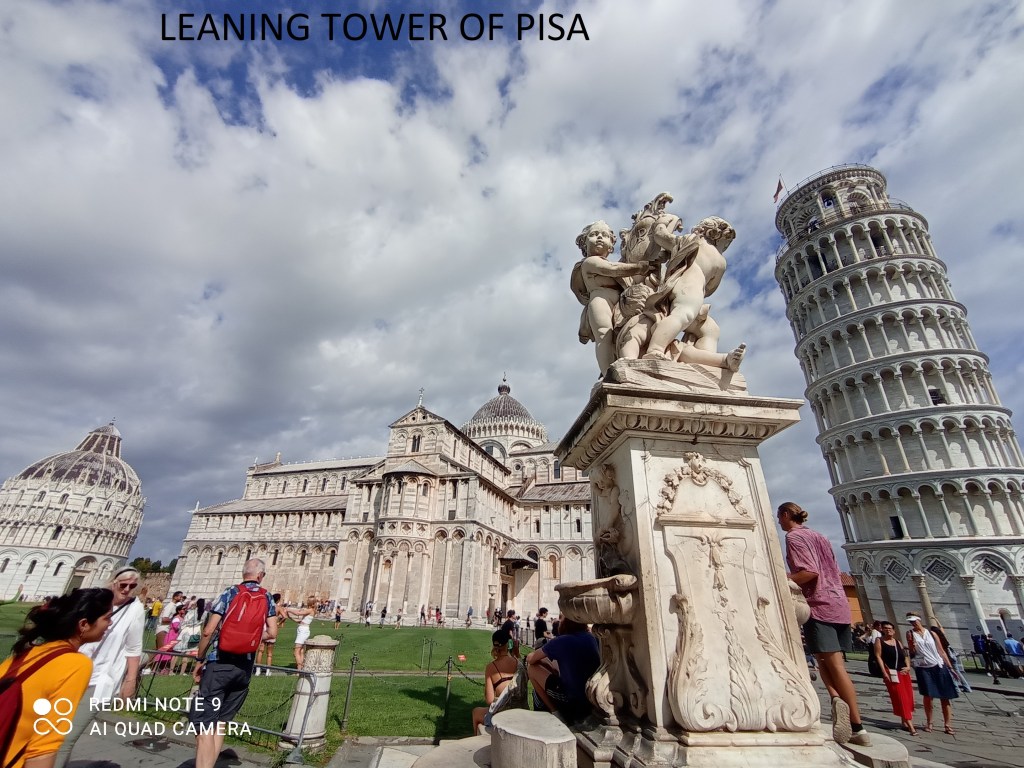
In the Cathedral Square there is a beautiful drinking- water fountain for the convenience of the visitors -the Fontana dei Putti.
My dear readers may kindly point out any incorrect information in my above writeup needing any corrections! I am truly indebted to Wikipedia & for the invaluable information on the subject !Happy Reading !
 Travel and Share
Yet another marvel!
Reading about places like this makes us realise that there is so much to explore in the world.History and architecture is the most intriguing part about European countries and cover it so well.
Kudos to your hardwork!
LikeLiked by 1 person
Thank you so much for the lovely comments 👍
LikeLike
I missed to visit pisa during my trip to Italy but now through your blog I have got so much details that I will definitely but Pisa and leaning tower on my list for the next time.
LikeLiked by 1 person
Surely you can plan visiting the leaning Tower as well as other attractions of Pisa in your next visit 👍
LikeLike