

ABOUT PHILIPS :
Philips is a multinational technology company that is engaged in the healthcare, lighting, and consumer well-being markets. It operates through the following segments: Healthcare, Consumer Lifestyle, Lighting, and Innovation, Group and Services. The Healthcare segment offers imaging systems, patient care and clinical informatics, home healthcare solutions, and customer services. The Consumer Lifestyle segment involves health and wellness, personal care, domestic appliances, television, audio and video multimedia, and accessories. The Lighting segment includes lamps, consumer and professional luminaires, lighting systems and controls, automotive lighting, packaged light-emitting diodes (LEDs), and LED solutions. The Innovation, Group and Services segment provides operating sectors with support through shared service centers. The company was founded by Anton Frederik Philips and Gerard Leonard Frederik Philips in 1891 in Eindhoven and is headquartered in Amsterdam, Netherlands.“ Here I would like to present the original history of the prestigious company (chronologically) to the present day to my interested & valued readers !The source of the information is Wikkipedia to whom I am so very grateful.My readers may be already aware that I am in Eindhoven, Netherlands on a 75 days trip upto 27th ,July 2024!Happy Reading Friends!


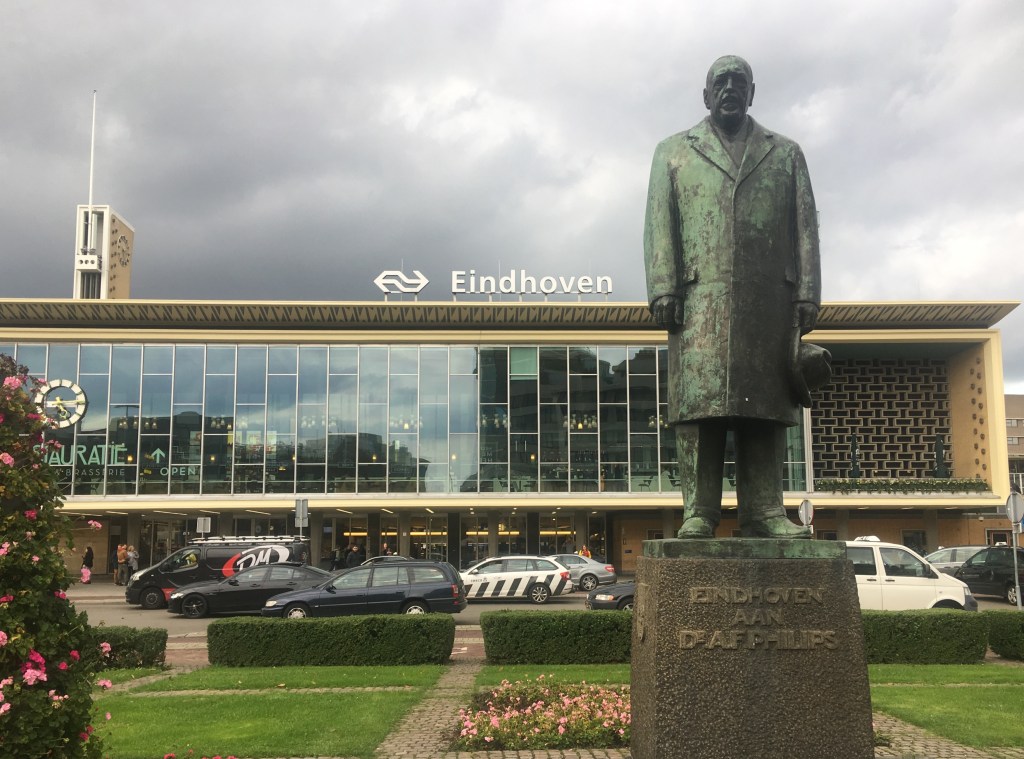


Koninklijke Philips N.V. (lit. ’Royal Philips’), commonly shortened to Philips, is a Dutch multinational conglomerate corporation that was founded in Eindhoven on 15 May 1891. Since 1997, it has been mostly headquartered in Amsterdam, though the Benelux headquarters is still in Eindhoven. Philips was formerly one of the largest electronics companies in the world but is currently focused on the area of health technology, having divested its other divisions. The Philips Company was founded in 1891, by Dutch-Jewish entrepreneur Gerard Philips and his father Frederik Philips with their first products being light bulbs.. Frederik, a banker based in Zaltbommel, financed the purchase and setup of an empty factory building in Eindhoven, where the company started the production of carbon-filament lamps and other electro-technical products in 1892. It currently employs around 80,000 people across 100 countries. The company gained its royal family title(hence the Koninklijke) in 1998 and dropped the “Electronics” in its name in 2013,due to its refocusing from consumer electronics to healthcare technology. Philips is organized into three main divisions: Personal Health (formerly Philips Consumer Electronics and Philips Domestic Appliances and Personal Care), Connected Care, and Diagnosis & Treatment (formerly Philips Medical Systems). The lighting division was spun off as a separate company, Signify N V. The company started making electric shavers in 1939 under the Philishave and Norelko brands, and post-war they developed the Compact Casette format and co-developed the Compact Casette format with Soni, as well as numerous other technologies. As of 2012, Philips was the largest manufacturer of lighting in the world as measured by applicable revenues. Philips has a primary listing on the Euronext Amsterdam stock exchange and has a secondary listing on the New York Stock Exchange. Acquisitions include that of Signetics and Mognavax. It also founded a multidisciplinary sports club called PSV Eindhoven in 1913


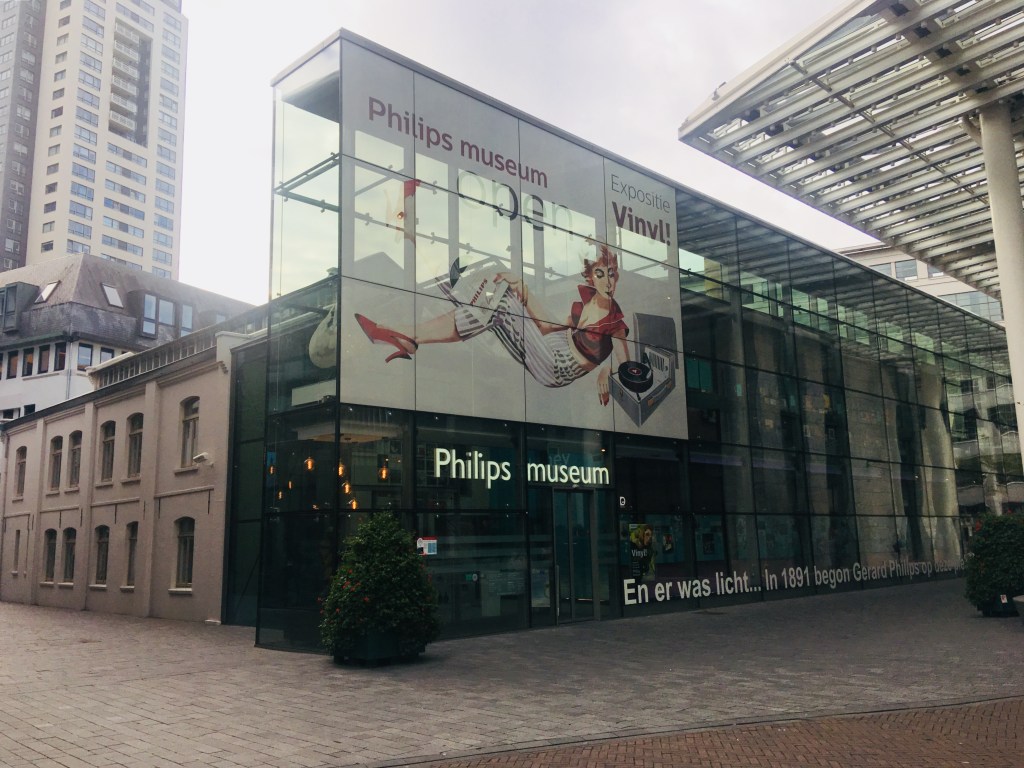
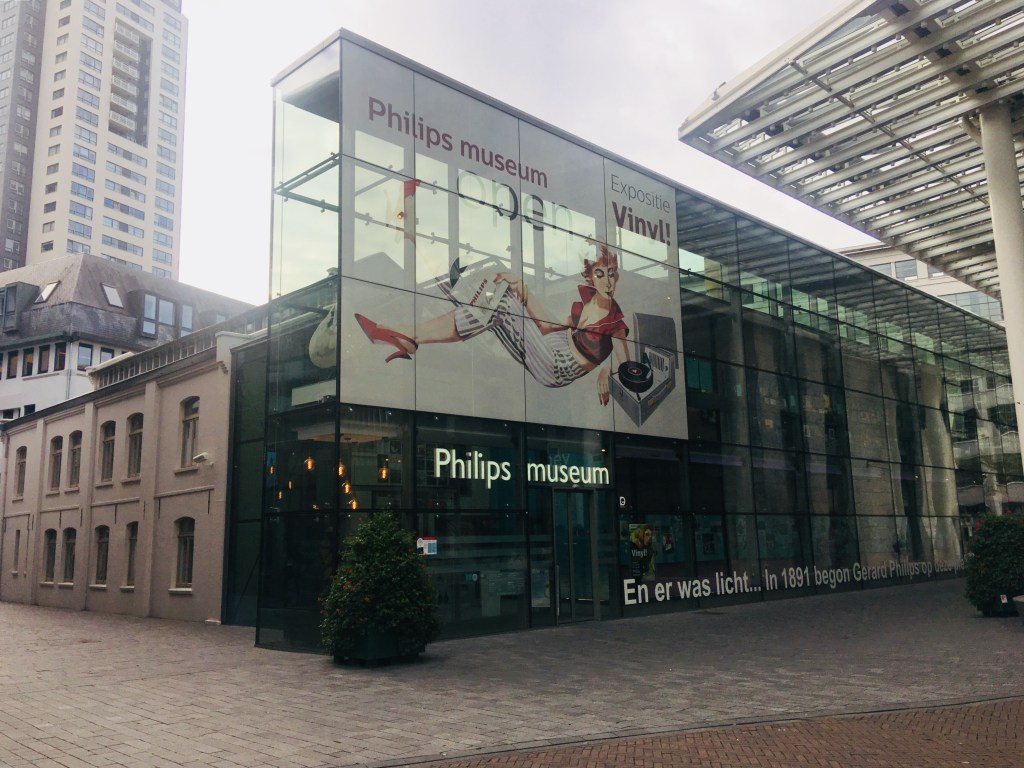
The Philips Company was founded in 1891, by Dutch-Jewish entrepreneur Gerard Philips and his father Frederik Philips. Frederik, a banker based in Zaltbommel, financed the purchase and setup of an empty factory building in Eindhoven, where the company started the production of carbon-filament lamps and other electro-technical products in 1892.The very first Philips factory in Eindhoven is now a public museum.
The Philips Museum is located in the center of Eindhoven, where Gerard Philips produced his first light bulbs in 1891. Here you will be taken into the story of the company. You see how Philips is constantly reinventing itself and how it plays an important role in social change with innovative technology. First with electric light, later with radio, television and the arrival of the digital age. And right now Philips is at the forefront of major changes in healthcare. Always with the aim: To improve people’s lives..
HISTORY OF THE PHILIPS COMPANY :
The Philips Company was founded in 1891, by Dutch-Jewish entrepreneur Gerard Philips & his father Frederik Philips who set started the production of carbon-filament lamps & other electro-technical products in 1892 in an empty factory building in Eindhoven.In 1895, after a difficult first few years and near-bankruptcy, the Philipses brought in A, Gertard’s younger brother by sixteen years. Though he had earned a degree in engineering, Anton started work as a sales representative & soon he began to contribute many important business ideas. With Anton’s arrival, the family business began to expand rapidly, resulting in founding of Philips Metaalgloeilampfabriek N.V. (Philips Metal Filament Lamp Factory Ltd.) in Eindhoven in 1908, followed in 1912, by the foundation of Philips Gloeilampenfabrieken N.V. (Philips Lightbulb Factories Ltd.). After Gerard & Anton Philips changed their family business by founding the Philips corporation, they laid the foundations for the later multinational. In the 1920s, the company started to manufacture other products, such as vacuum tubes.
Radio :
On 11 March 1927, Philips went on the air, inaugurating the shortwave radio station PCJJ (later PCJ) which was joined in 1929 by a sister station (Philips Omroep Holland-Indië, later PHI). PHOHI broadcast in Dutch to the Dutch East Indies (now Indonesia), and later PHI broadcast in English and other languages to the Eastern hemisphere, while PCJJ broadcast in English, Spanish and German to the rest of the world. The international program Sundays commenced in 1928, with host Eddie Startz hosting the Happy Station show, which became the world’s longest-running shortwave program. Broadcasts from the Netherlands were interrupted by the German invasion in May 1940. The Germans commandeered the transmitters in Huizen to use for pro-Nazi Broadcasts, some originating from Germany, others concerts from Dutch broadcasters under German control. In the early 1930s, Philips introduced the “Chapel”, a radio with a built-in loudspeaker. Philips Radio was absorbed shortly after liberation when its two shortwave stations were nationalised in 1947 and renamed Radio Netherlands Worldwide, the Dutch International Service. Some PCJ programs, such as Happy Station, continued on the new station.
Stirling engine: Philips was instrumental in the revival of the Stirling engine when, in the early 1930s, the management decided that offering a low-power portable generator would assist in expanding sales of its radios into parts of the world where mains electricity was unavailable and the supply of batteries uncertain. Engineers at the company’s research lab carried out a systematic comparison of various power sources and determined that the almost forgotten Stirling engine would be most suitable, citing its quiet operation (both audibly and in terms of radio interference) and ability to run on a variety of heat sources (common lamp oil – “cheap and available everywhere” – was favored). They were also aware that, unlike steam and internal combustion engines, virtually no serious development work had been carried out on the Stirling engine for many years and asserted that modern materials and know-how should enable great improvements: In parallel with the generator set, Philips developed experimental Stirling engines for a wide variety of applications and continued to work in the field until the late 1970s, though the only commercial success was the ‘reversed Stirling engine’ cryocooler. However, they filed a large number of patents and amassed a wealth of information, which they later licensed to other companies. Shavers: The first Philips shaver was introduced in 1939, and was simply called Philishave. In the US, it was called Norelco. The Philishave has remained part of the Philips product line-up until the present. World War II :On 9 May 1940, the Philips directors learned that the German invasion of the Netherlands was to take place the following day. Having prepared for this, Anton Philips and his son-in-law Frans Otten, as well as other Philips family members, fled to the United States, taking a large amount of the company capital with them. Operating from the US as the North American Philips Company, they managed to run the company throughout the war. At the same time, the company was moved (on paper) to the Netherlands Antilles to keep it out of German hands.
Fritz Philips, the son of Anton, was the only Philips family member to stay in the Netherlands. He saved the lives of 382 Jews by convincing the Nazis that they were indispensable for the production process at Philips. In 1943, he was held at the internment camp for political prisoners at Voutte for several months because a strike at his factory reduced production. For his actions in saving the hundreds of Jews, he was recognized by Yad Vasham in 1995 as a “Righteous among nations”.
1945-95 :After the war, the company was moved back to the Netherlands, with their headquarters in Eindhoven.
The Philips Light Tower in Eindhoven, originally a light bulb factory and later the company headquarters.
The Evoluon in Eindhoven was opened in 1966. Originally a science museum, the distinctively designed Evoluon in Eindhoven is now a sleek, modern conference center. This famous landmark has secured the coveted Benelux’s highest possible rating, of ‘5 hammers’ and vaunts an events venue that can accommodate up to 1500 visitors.


Frits Philips commissioned the Evoluon to commemorate the Philips company’s 75th anniversary in 1966 and gifted it to the public. The Evoluon was extremely popular, attracting over 500,000 visitors in 1970 with its thought-provoking science and technology exhibits that encouraged visitor interaction.


In 1949, the company began selling television sets In 1950, it formed Philips Records, which eventually formed part of PolyGram in 1962. Philips introduced the Compact Cassette audio tape format in 1963, and it was wildly successful. Cassettes were initially used for dictation machine for office typing stenographers and professional journalists. As their sound quality improved, cassettes would also be used to record sound and became the second mass media alongside vinyl Records used to sell recorded music.Philips introduced the first combination portable radio and cassette recorder, which was marketed as the “radio recorder”, and is now better known as the boombox. Later, the cassette was used in a telephone answering machines, including a special form of cassette where the tape was wound on an endless loop. The C-cassette was used as the first mass storage device for early personal computers in the 1970s and 1980s. Philips reduced the cassette size for professional needs with the Mini-Cassettes, although it would not be as successful as the Olympus Microcassettes. This became the predominant dictation medium up to the advent of fully digital dictation machines. Philips continued with computers through the early 1990s.In 1972, Philips launched the world’s first home videocassette Recorder, in the UK, the N1500.In 1982, Philips teamed with Sony to launch the Compact Disc; this format evolved into the CD-R,CD-RW, DVD and later Blu-ray, which Philips launched with Sony in 1997 and 2006 respectively.
In 1984, the Dutch Philips Group bought out nearly a one-third share and took over the management of the German company Grundig. In 1984, Philips split off its activities on the field of photolithographic. integrated circuit production equipment, the so-called wafer steppers, into a joint venture with ASM International, under the name ASML in Eindhoven. Over the years, this new company has evolved into the world’s leading manufacturer of chip production machines at the expense of competitors like Nikon and Canon. In the 1980s, Philips’s profit margin dropped below 1 percent, and in 1990 the company lost more than US$2 billion (biggest corporate loss in Dutch history). Troubles for the company continued into the 1990s as its status as a leading electronics company was swiftly lost. In 1985, Philips was the largest founding investor in TSMC which was established as a joint venture between Philips, the Taiwan government and other private investors.
In 1991, the company’s name was changed from N.V. Philips Gloeilampenfabrieken to Philips Electronics N.V. At the same time, North American Philips was formally dissolved, and a new corporate division was formed in the US with the name Philips Electronics North America Corp. In 1997, the company officers decided to move the headquarters from Eindhoven to Amsterdam along with the corporate name change to Koninklijke Philips Electronics N.V., the latter of which was finalized on 16 March 1998. In 1998, looking to spur innovation, Philips created an Emerging Businesses group for its Semiconductors unit, based in Silicon valley. The group was designed to be an incubator where promising technologies and products could be developed.
The move of the headquarters to Amsterdam was completed in 2001. Initially, the company was housed in the Rembrandt Tower. In 2002, it moved again, this time to the Breitner Tower. Philips Lighting, Philips Research, Philips Semiconductors (spun off as NXP in September 2006), and Philips Design, are still based in Eindhoven. Philips Healthcare is headquartered in both Best,Netherlands (near Eindhoven) and Andover Massachussetts, United States.
In 2000, Philips bought Optiva Corporation, the maker of Sonicare Electric Toothbrushes. The company was renamed Philips Oral Healthcare and made a subsidiary of Philips DAP. In 2001, Philips acquired Agilent Technologies Healthcare Solutions Group (HSG) for EUR 2 billion.[31] Philips created a computer monitors joint venture with LG called LG Philips displays in 2001. In 2001, after growing the unit’s Emerging Businesses group to nearly $1 billion in revenue, Scot A McGregore was named the new president and CEO of Philips Semiconductors. McGregor’s appointment completed the company’s shift to having dedicated CEOs for all five of the company’s product divisions, which would in turn leave the Board of Management to concentrate on issues confronting the Philips Group as a whole.In February 2001 Philips sold its remaining interest in battery manufacturing to its then partner Matsushita (which itself became Panasonic in 2008). In 2004, Philips abandoned the slogan “Let’s make things better” in favor of a new one: Sense & Sensibility and in 2013 to Innovation and You .
In 2006, Philips bought out the company Lifeline Systems headquartered in Framingam,Massachusetts, in a deal valued at $750 million, its biggest move yet to expand its consumer-health business (M).In August 2007, Philips acquired the company Ximis, Inc. headquartered in El Paso Texas, for their Medical Informatics Division.In October 2007, it purchased a Moore Microprocessor Patent (MPP) Portfolio license from The TPL Group.On 21 February 2008, Philips completed the acquisition of VISICU in Baltimore, Maryland, through the merger of its indirect wholly-owned subsidiary into VISICU. As a result of that merger, VISICU has become an indirect wholly-owned subsidiary of Philips. VISICU was the creator of the eICU concept of the use of Telemedicine from a centralized facility to monitor and care for ICU patients.
Philips made several acquisitions during 2011, announcing on 5 January 2011 that it had acquired Optimum Lighting, a manufacturer of LED based luminaires. In January 2011, Philips agreed to acquire the assets of Preethi, a leading India-based kitchen appliances company. On 27 June 2011, Philips acquired Sectra Mamea AB, the mammography division of Sectra AB. Following two decades in decline, Philips went through a major restructuring, shifting its focus from electronics to healthcare. Particularly from 2011 when a new CEO was appointed, Frans van Houten. The new health and medical strategy have helped Philips to thrive again in the 2010s. On 29 January 2013, it was announced that Philips had agreed to sell its audio and video operations to the Japan-based Funai Electric for €150 million. In April 2013, Philips announced a collaboration with Paradox Engg for the realization and implementation of a “pilot project” on network-connected street-lighting management solutions. This project was endorsed by the San Francisco Public Utilities Commission(SFPUC). In 2013, Philips removed the word “Electronics” from its name – becoming Royal Philips N.V. On 13 November 2013, Philips unveiled its new brand line “Innovation and You” and a new design of its shield mark. The new brand positioning is cited by Philips to signify company’s evolution and emphasize that innovation is only meaningful if it is based on an understanding of people’s needs and desires.
The Philips Physics Laboratory was scaled down in the early 21st century, as the company ceased trying to be innovative in consumer electronics through fundamental research. On 23 September 2014, Philips announced a plan to split the company into two, separating the lighting business from the healthcare and consumer lifestyle divisions. It moved to complete this in March 2015 to an investment group for $3.3 billion. In February 2015, Philips acquired Volcano Corporation to strengthen its position in non-invasive surgery and imaging.In June 2016, Philips spun off its lighting division to focus on the healthcare division.In June 2017, Philips announced it would acquire US-based Spectranetics Corp, a manufacturer of devices to treat heart disease, for €1.9 billion (£1.68 billion) expanding its current image-guided therapy business.
Health ,wellness & personal care is now called “Personal Health”
In May 2016, Philips’ lighting division Philips Lighting went through a spin -off process, and became an independent public company named Philips Lighting N.V.In 2017, Philips launched Philips Ventures, with a health technology venture fund as its main focus. Philips Ventures invested in companies including Mytonomy (2017) and DEAR health (2019).In 2018, the independent Philips Lighting N.V. was renamed Signify NV However, it continues to produce and market Philips-branded products such as Philips Hue color-changing LED light bulbs.Lighting & domestic appliances business is now sold out.
Notable Family members of Philips family :
Corporate affairs:Past and present CEOs:
1)1891–1922: Gerard Philips ,
2)1922–1939: Anton Philips ,
3)1939–1961: Frans Otten
4)1961–1971: Frits Philips,———–
13)2011 to 2022 :Frans van Houten
14)2022 to the present :Roy Jakobs
Operations :
Philips is registered in the Netherlands as a public corporation and has its global headquarters in Amsterdam. At the end of 2013, Philips had 111 manufacturing facilities, 59 R&D facilities across 26 countries and sales and service operations in around 100 countries. Philips began its operations in India in the year 1930.
Philips is organized into three main divisions:
1) Philips Consumer Lifestyle (formerly Philips Consumer Electronics and Philips Domestic Appliances& Personal Care), 2)Philips Healthcare (formerly Philips Medical Systems),&3) Philips Lighting (Former).
‘The strategic focus & view on Healthcare’ as per Philips in their own words : Our strategic focus : At Philips, our purpose to improve people’s health and well-being through meaningful innovation is at the center of everything we do. This core principle has never been more important than it is in these challenging times. As a leading health technology company, we believe that – viewed through the lens of customer needs – innovation can improve people’s health and healthcare outcomes, as well as making care more accessible, personal, connected and sustainable. In concrete terms, we aim to improve lives of 2 billion people a year by 2025, including 300 million in underserved communities, rising to 2.5 billion and 400 million resp. by 2030.
Guided by this purpose, it is our strategy to lead with innovative solutions that combine products, systems, software and services and leverage clinical and operational data, to help our customers deliver on the Quadruple Aim (better health outcomes, improved patient experience, improved staff experience, lower cost of care) and help people take better care of their health at every stage of life. We strive to deliver superior, long-term value to our customers and shareholders, while acting responsibly towards our planet and society, in partnership with our stakeholders.
Our view on healthcare :
Besides the healthcare sector’s natural drivers of growth – aging populations, the rise of chronic diseases, increased spending on healthcare in emerging markets – we believe that health technology will be a major growth driver in the years to come. At Philips, we see healthcare as a continuum – this puts people’s health journeys front and center and enables integrated care pathways. Believing that healthcare should be safe, seamless, efficient and effective, we strive to ‘connect the dots’ for our customers and consumers, supporting the flow of real-time data needed to provide precision diagnoses, treatment and chronic care for patients .
My dear readers may kindly point out any incorrect information in my above writeup needing any corrections! I am truly indebted to Wikipedia for the invaluable information on the subject !Happy Reading !
 Travel and Share


.svg)
You have given a very detailed history and evolution of Philips. Very informative indeed!
LikeLiked by 1 person
Thank you so much for your encouraging comments dear Sir! Have a nice weekend 🌷♥️🙏
LikeLiked by 1 person
It’s my pleasure, Dhirendra ji. All the best and have a great weekend 🎉💖💐🙏
LikeLiked by 1 person
🙏🏾
LikeLiked by 1 person
The historical perspective enunciated about the history of PHILIPS ENTERPRISES is obviously very interesting and historical. The company was started in1891 and the way this company excelled from making Philips bulbs and other utility items and presently is delving and showcasing its expertise in HEALTH CARE sector is really marvelous.
The family tree mentioned in your write up is also very historical.. The name of KARL MARX was without doubt is not only a history making but a HISTORY in his own right. Coming from such a back ground speaks volume.
Whatever products PHILIPS COMPANY produces, it leaves behind a rare name for itself and the consumers buy these products without even a second thought for this company with its finetuned legacy of QUALITY FIRST is a trademark of excellency and professionalism of first order.
Thanks sharing an excellent write up on PHILIPS COMPANY.
WITH REGARDS
HARBANS
LikeLiked by 1 person
I am overwhelmed by your beautiful appraisal of the blog on Philips underlining it’s marvellous rise from Light bulbs makers to Health Care professionals of repute addressing the Global Health concerns!I am feeling genuinely mesmerised to be amidst Philips installations in their place of birth, Eindhoven! It’s a unique experience not to be described in words ! Thanks dear for your insightful comments!Have a great Sunday💕🙏🏾
LikeLiked by 1 person
Actually, the write up you have penned down was so unique that even a novice will endorse it to be one amongst the best.
You’ve have in fact enlightened me in many ways by giving input which I was not aware of.
Thanks enlightening.
Thanks and regards.
LikeLiked by 1 person
I am blessed if you think so! Har har Mahadew 🙏🏾Have a nice day
LikeLiked by 1 person
HSR HAR MAHADEV JI. MAY HIS BLESSINGS REMAIN ON ALL OF US. WARM REGARDS.
LikeLiked by 1 person
🙏🏾
LikeLike
Thanks and regards.
LikeLiked by 1 person
Being on my tour to new places , I have posted another blog!Pl see🙏
LikeLike
Warm regards.
LikeLiked by 1 person
Pl visit Berlin through my two new posts, Sir 🙏🏾
LikeLiked by 1 person
I shall certainly. Warm regards.
LikeLiked by 1 person
🌷🙏
LikeLike
Warm regards.
LikeLiked by 1 person
Sir, very detailed and insightful blog on Philips. Being from scientific community you must have enjoyed this visit. Very informative article. Thank you for your hard work in bringing such excellent blogs for us.
LikeLiked by 1 person
Thanks dear for your lovely 💕words of praise and encouragement! Have a nice day both of you 🌷🙏
LikeLike
It is sheer talent to write such an interesting info about a company.The best part was that you walked us through the journey of the company with the refrences which keeps the blog interesting.
LikeLiked by 1 person